


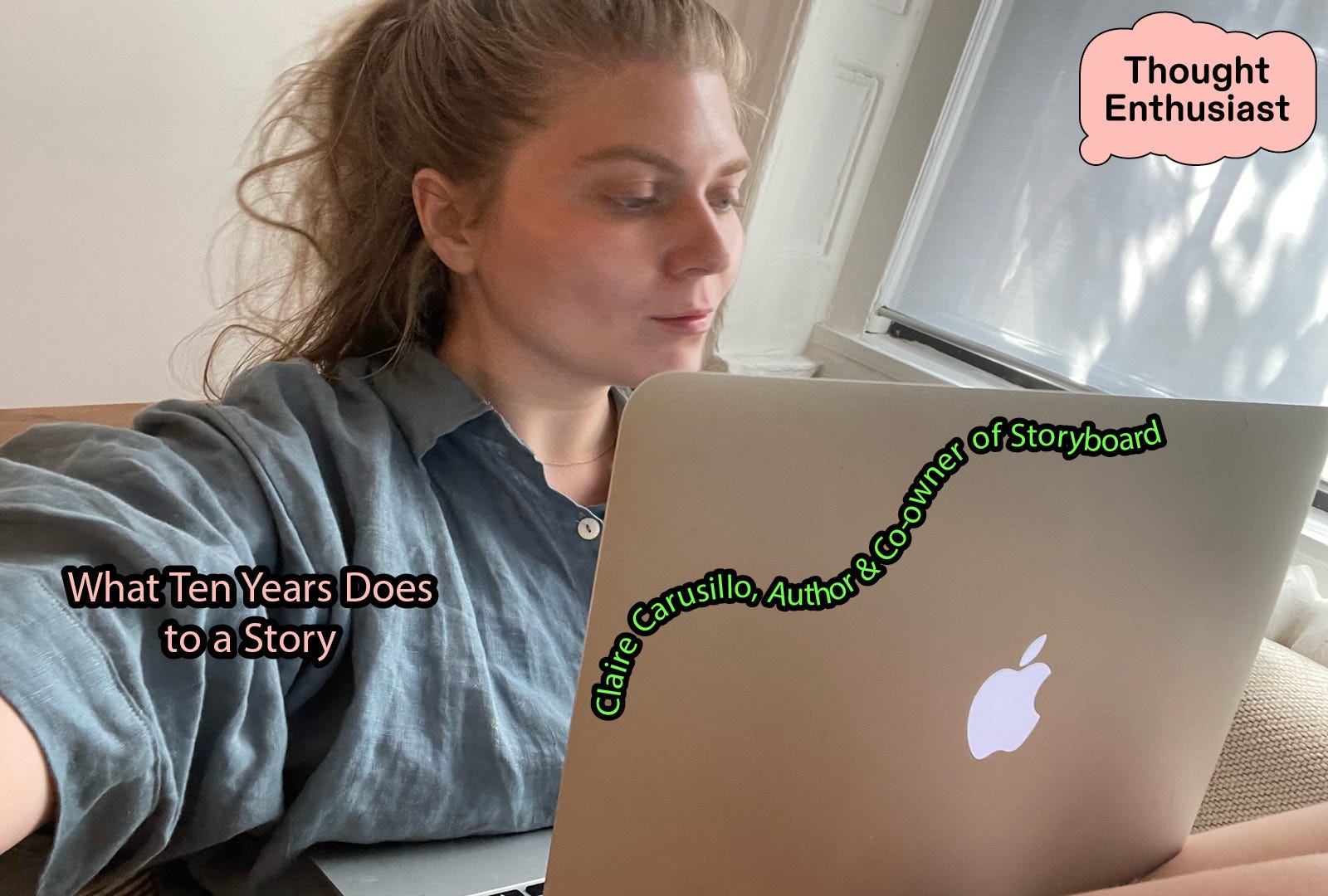
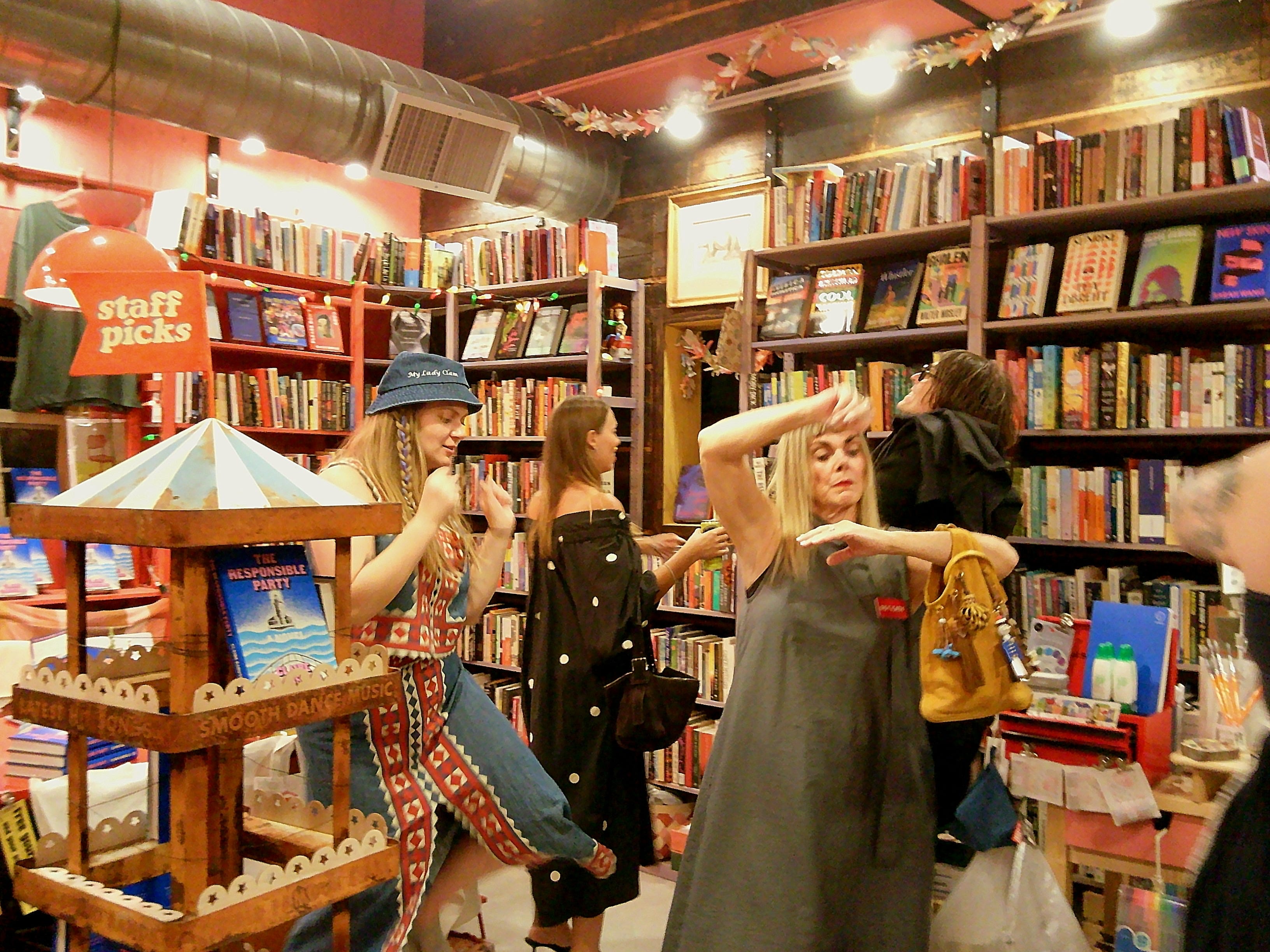
Claire’s debut novel came out last month and has already made a splash in the lit world for its unique concept, voicey writing and very funny perspective from someone who has clearly spent a lot of time on the internet.
This week she stops by the studio to chat about a decade of writing and the NY to Utah pipeline.
Claire Carusillo is the co-owner of Storyboard, a bookstore, skate shop, and coffee bar in Midway, UT. Her debut novel The Responsible Party is out now.
Thought Enthusiast is an editorial project from AdHoc, a New York experiential agency exploring the people, ideas, and cultural currents shaping what’s next.
A Very Long Overnight Success
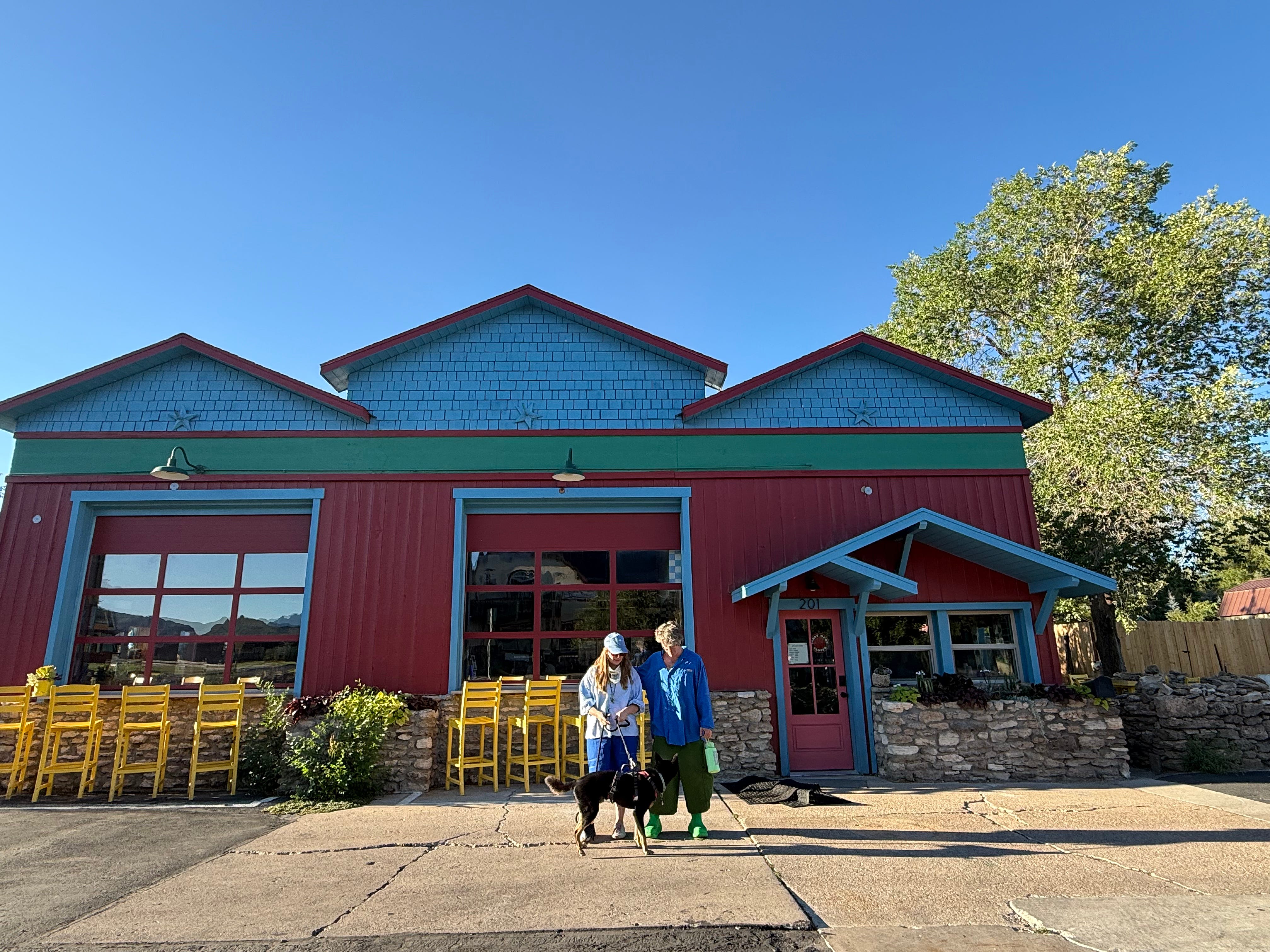
I’ve been toiling in obscurity for so long. And then the two craziest things that have happened to me career-wise happened within two months of each other. I was working on the book for about 10 years. Much of the creative process of the last three years was physically building a business. We had a contractor who did the electric and the tile, but we, along with my sister, did all of the interiors ourselves. It was balancing labor alongside writing and rewriting.
I got a book deal two years before the book came out, and a condition of my contract was that I had to take 50 pages out. It took us two full years to open the business because the book deal happened three months after we bought this place. A lot of stuff was happening at the same time. It was probably the worst two years of my life.
Claire, Again
The other wrinkle here is that I decided to name my narrator Claire Carusillo, which is my name. The central relationship in the book between the narrator and her mother is inspired by my own relationship with my mother, or at least what it resembled at some point over the course of writing. I just turned 35, and I started writing this book as a 25-year-old. I would like to think that I have evolved in the way that I react to situations. And yet there is this version of myself whose explosions and insecurities I’ve been fine-tuning in the editing process for ten years. She’s the best worst version of a younger me. It’s been very strange, and at times it’s depressing to be stuck with that version of myself.
This book is about a stagnant summer where the narrator moves back in with her mother and father. I have randomly lived in Utah twice and New York twice since I started writing this book, ping-ponging back and forth geographically. For the character version of me, there’s absolutely no movement. I’ve never really written about New York, and I’ve never written about Utah in any significant way, because I’ve always been working on this book instead. It’s a Midwest story as written by someone who hasn’t spent much time there at all since she lived with her parents.
Maybe This Is Not Good
I came of age blogging and newslettering, and one of my core principles is that writing drafts of fiction as if my words are as disposable as they are online kills the censor and releases some pressure from the seriousness of it all. Especially if you’re in the editing or rewriting stage and you’re not getting much traction. I faced so much rejection with this book. I kept rewriting and editing after seven or eight years, past the time when most people might say, “Maybe this is not good. Maybe this is time to work on something new or put this away”. There was always some tiny glimmer in my belly that told me this could be a book. I honestly think that the only difference between me being an unpublished writer and a published writer is that I decided to keep going. It’s not even that I have remarkable self-esteem or self-belief. It was just a constant, occupying hum of I don’t know how I’m going to do this but it will get done.
There’s always been a recurring theme in writing feedback from friends, professors, or my editors: I always need to be reined in. I love writing tangential asides because they so efficiently lead a reader to understand a background character’s purpose by humanizing them a sentence or two beyond what’s typical. Now that the book is finally out and I’m hearing institutional feedback, which is also pretty wacko because there were years and years in which I had no feedback, people are calling it “maximalist”. That’s not a word I had ever heard used to describe my writing style. It’s never been, “Tone it down.” It’s, “Tighten it up.”
Blame the Foremothers
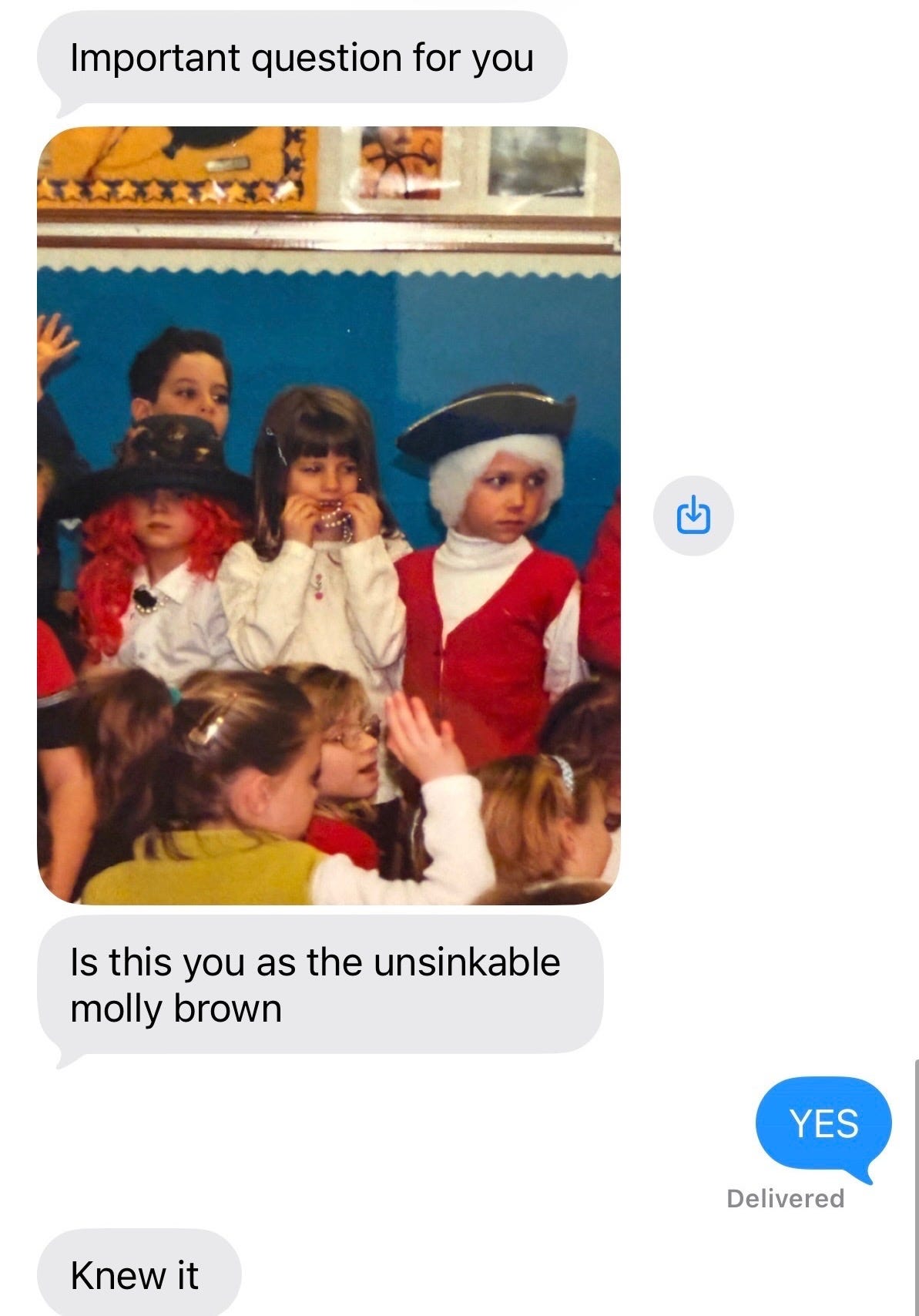
Much of the book is about how each generation chips away at the family identity that the previous one dedicated their lives to upholding. The character Claire grew up with her mom telling her this epic ancestral tale of shipwrecks and stolen identity in instances when she didn’t see young Claire embodying any type of hardiness. The foremothers were all about hardiness. That’s a big theme of the book: the ways that we disappoint the generations before us.
My mom is really funny. As I get a little bit older, I understand her big reactions to the wrongs of the world. I try not to respond to bad behavior with worse behavior, yet I’m always fighting some base nature of mine to react to situations exactly as my foremothers did. I’m just as theatrical in my response to some slight as the ones who came before me. It was important to me as a sign of respect that the narrator Claire’s mother Kath – who is not my mother in real life – was funnier and better adjusted to the world than the narrator Claire. I never wanted her to get the last laugh. A lot of the book takes place when Kath is a 17-year-old, and I didn’t know my mom when she was 17. I had to write those scenes based on how I was as a 17-year-old or how my sister Julia was as a 17-year-old.
A Voice of a Generation
A writer’s dream is that someone buys the rights to this and never makes it into anything, but I’d still get paid like $6,000. If this were a television show, I envision three different timelines and three different casts:a present-day timeline, a 1970s partying timeline, and then a shipwreck timeline, all filtered through the contemporary narrator Claire’s head. The way that I’ve divided the book is basically in five sections. Each section of the present day murder mystery and the retelling of Kath’s high school years in the is punctuated by a 10-page old-timey history section. Maybe movies are where it’s at, but the sprawlingness of a limited television series would be amazing. Me and my mom have no formal acting training, but it would be really funny if me and my mom played me and my mom.
I’ll always stan Lena Dunham. She is the funniest writer who has ever had the opportunity to helm a television show. Girls came out when I was a junior in college, and a lot of the trajectory of my life, or maybe just moving to Brooklyn after college or whatever, was probably influenced by it. In that show, she’s a Midwesterner, and we even both had that double thing going on in our names: Hannah Horvath, Claire Carusillo, the alliteration.
More thoughts soon.
Follow Claire on Instagram

AdHoc’s campaigns live in the spirit of creating experiences with an emphasis on the unconventional, unfounded, and new to build things that feel culturally embedded and considered rather than overbranded and boring. Want to make something cool together? Hit us up at partnerships@adhoc.xyz
thank you michy!!!!