


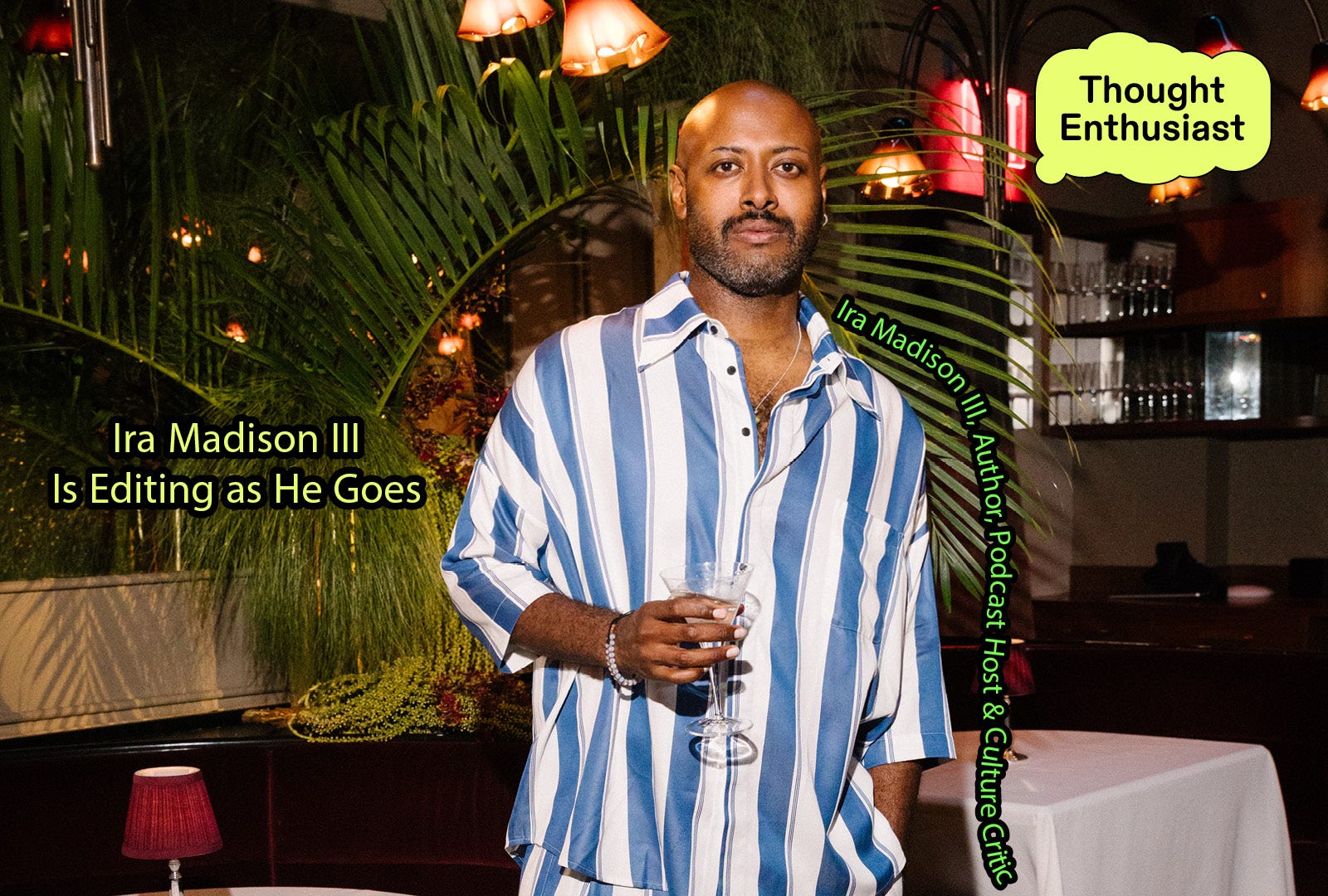
Ira is staying busy – working on his first novel, recently publishing a couple of short stories, and starting a new podcast called Feedback with Ira Madison III.
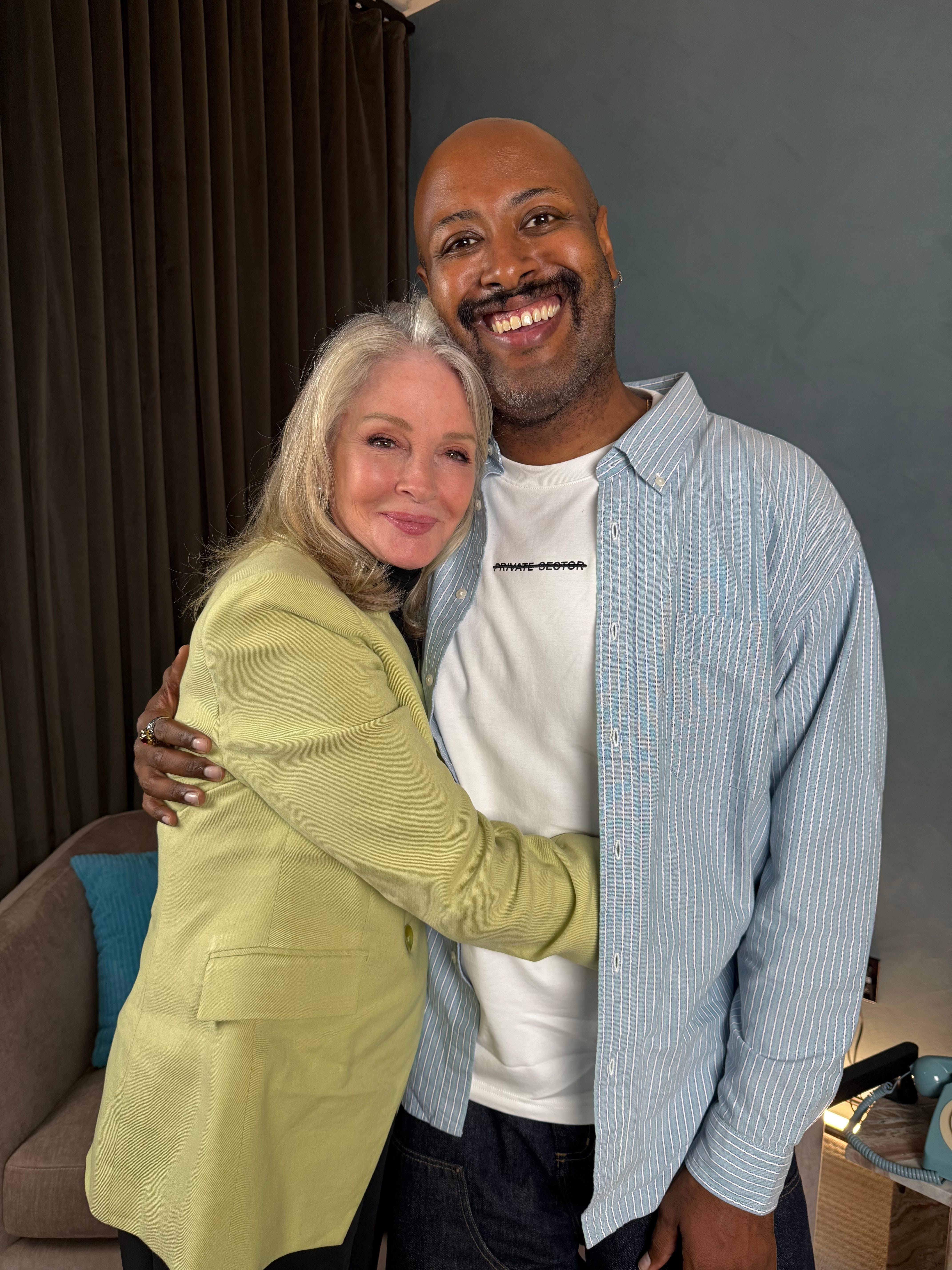
This week, he stops by the studio to talk about serializing a Substack novella, what he has learned about interviewing people over the years, and a look into his rich inner world.
Ira Madison III is the author of the nationally best-selling Pure Innocent Fun: Essays, called "a brilliant critical voice" by Kirkus Reviews and "humorous and perceptive" by The Washington Post, and host of the culture podcast Feedback with Ira Madison III. He is the former host and creator of the pop culture podcast Keep It (Webby Awards People’s Voice Award 2021 & 2023, iHeartRadio Best Pop Culture Podcast 2022). He has also written for GQ, Harper's Bazaar, New York, Interview, and MTV News, among other publications. His television writing credits include Uncoupled, Q-Force, Nikki Fre$h, and Daybreak. He lives in Brooklyn.
Thought Enthusiast is an editorial project from AdHoc, a New York experiential agency exploring the people, ideas, and cultural currents shaping what’s next.
The Substack Novella Structure
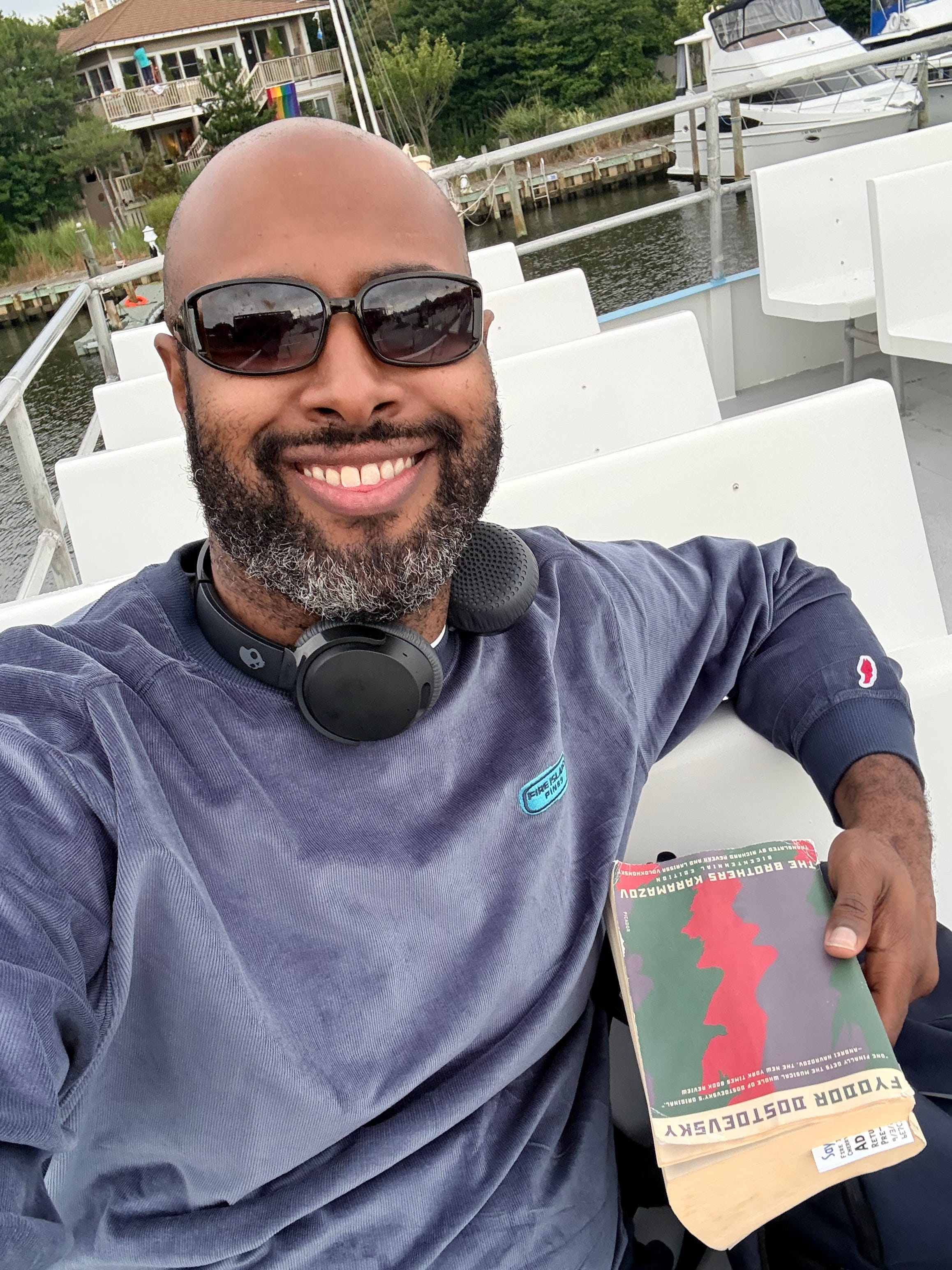
I’m working on a novel and a novella at the same time. The novella is set in the world of race, reality TV, fandoms, and parasocial relationships. I’m almost done with the novella. It’s going to be a six-installment thing that I plan to serialize on Substack. I’ve become really interested in talking with writers about craft, revision, and editing through the podcast. There’s so much unedited stuff on Substack. That’s kind of the whole thing. What I think you can show in a really interesting way is the editing and revision process. You put something on there and serialize it with the hope that later, I’ll edit it with an editor and it becomes a finished project. I’m showing my work in a way that ties into the tradition of serialization. It’s really a whole experiment.
Bonfire of the Vanities was serialized. Dostoevsky did it when he was writing The Brothers Karamazov. Charles Dickens did it as well. They were writing as they went and sometimes responding to critics, editing things, or dropping storylines depending on the reaction. I’m really interested in Substack as a live, living, breathing tool. You can edit and change things as you go. Not to speak of the dead, but Kanye West, RIP. When he was continuously editing The Life of Pablo, I thought that was interesting. Substack feels like a perfect place to do that with writing. Rachel Reid was even saying it was much easier for her to break in as a romance writer because she was initially publishing only as an ebook. So many romance writers publish ebooks, and it’s easy to make changes to them.
The Mix of High and Low
I was a big TV watcher and reader as a kid. I used to record everything I watched on VHS. I’m old. I would record them on VHS and file them. I think it’s actually more ADHD, to be honest, because I’m very much not Type A. If you saw my room, it’s historically been a mess for years. Maybe that’s also why I have extensive meme folders and everything. I just organize stuff that way. Pop culture and things like that have always been in my brain. I’m a Leo. A July Leo as well. No Virgo, not even in my chart, I believe. I wanted to write Goosebumps books as a kid. Then I got into TV, Passions, Days of Our Lives, Buffy, that kind of stuff. I commented on forums. I wrote fan fiction. Eventually, I discovered theater in school and loved playwriting, so I went to school for it.
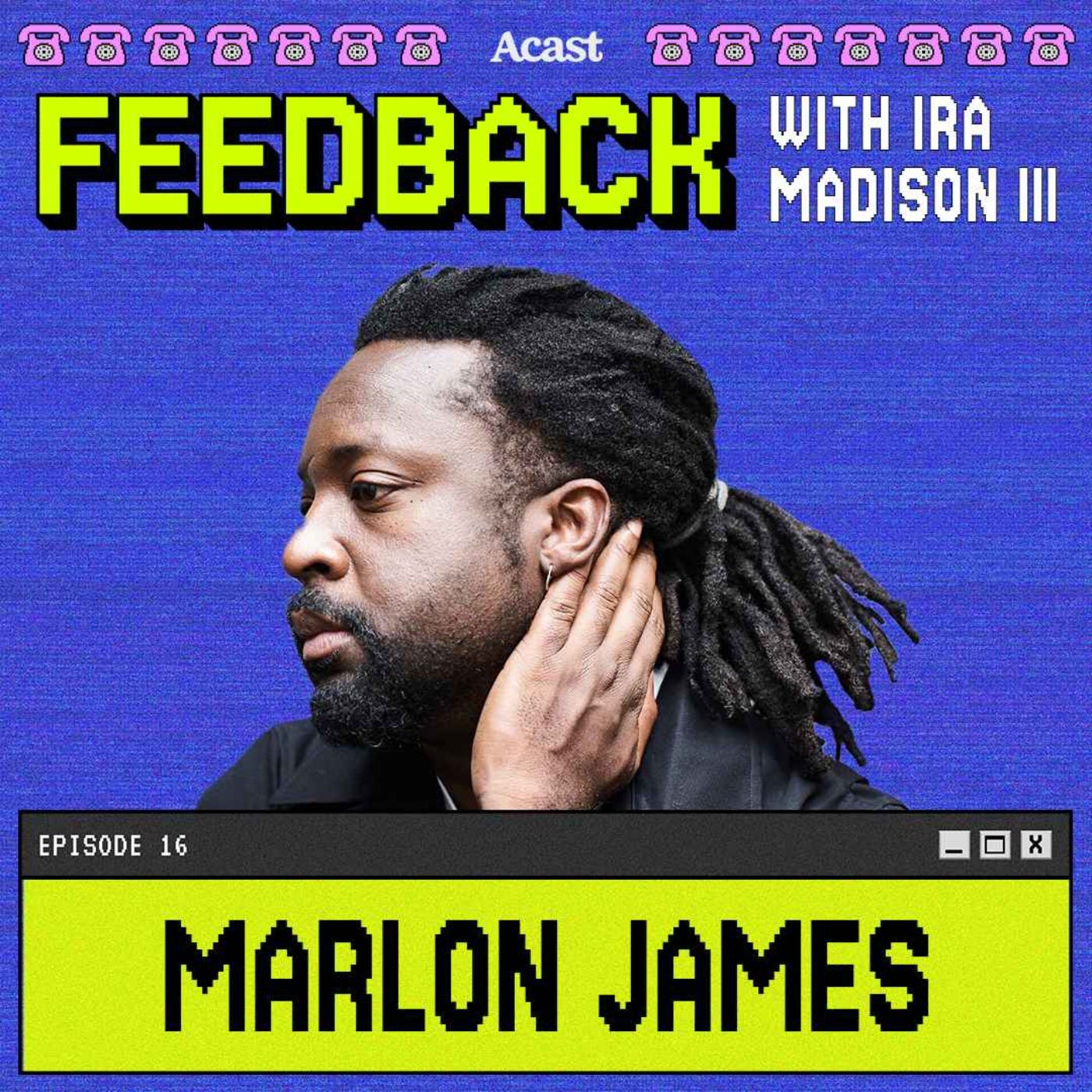
Leaving Keep It! was a conversation. Popular culture is so ephemeral, but it also just moves so fast. Specifically, my show doesn’t cover the news weekly anymore. We used to have to record every Tuesday morning. I did that for eight years. I feel so free. I don’t have to think about what’s trending anymore. Now I just have conversations about arts and culture. Not to elevate that above pop culture, because obviously I love pop culture and still discuss it on the show. But I’m talking with writers, playwrights, and cultural tastemakers whose work I enjoy. It's still that mix of what people call high and low. I think that’s always just been who I am intrinsically. I interviewed Booker Prize winning author Marlon James, Chris Black from How Long Gone, and this week’s episode is Jessel from The Real Housewives of New York. I think that runs the gamut of my interests.

In Good Company
I asked Lena Dunham a question on her newsletter, and she responded, “Ira, thrilled to be speaking directly to the person who brought ‘Keep It!’ into the American lexicon. Does it ever annoy you when people feel compelled to say that phrase to you? Is it your ‘voice of a generation’? So glad to be boarding the 40 bus with you.” Then she said it was funny that in my intro, I mentioned feeling odd asking her the question which I won’t share because I’m secretly a very shy person. But she said she felt the same way about me, that I’d had such a unique and lengthy career that she was shocked I would feel any twinges of that “compare and despair” with other people’s careers. Just having that acknowledgment from someone whose writing was very important to me, especially as a millennial watching Girls, and knowing that Lena was aware of my work and complimentary of my career journey was a really nice highlight.
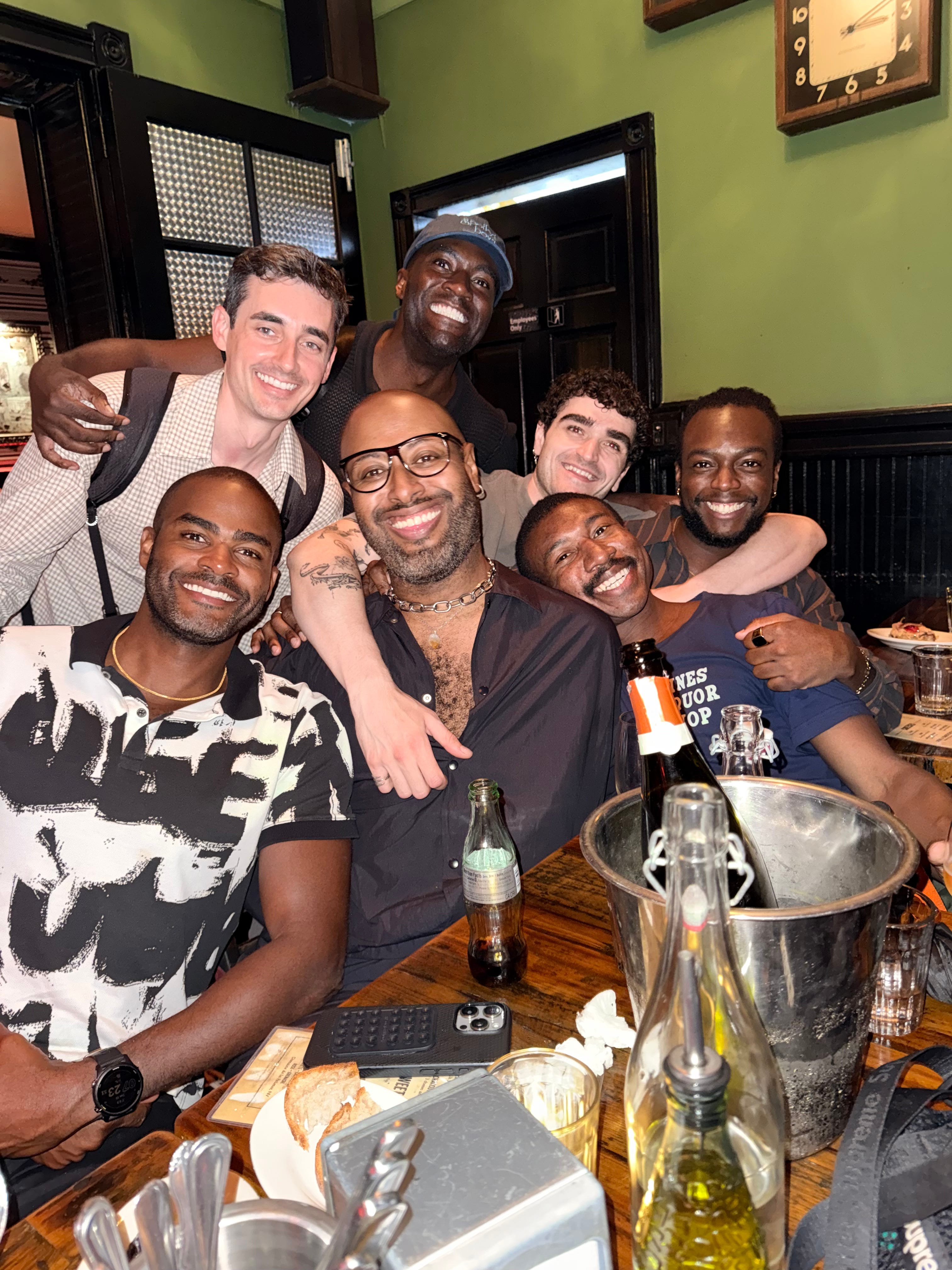
So many of my friends inspire me. Brendan Holder, who writes the newsletter Loosey, Peyton Dix, who’s a fantastic comedian and co-hosts Lemme Say This with Hunter Harris. Peyton and Hunter are eternally inspiring. My friend Teddy Goff is how I met Marlon James. Teddy is inspiring to me, and so is his husband, Christopher Jerrolds. They’re two friends I’ve met within the past few years who I’ve developed a really close relationship with. They’re very honest with me and encourage me to do better in my career and my personal life. They’ve made me a better person. I love them. They’re really good friends, and I’m lucky to have them.
The Cultural Context of Being a Critic
A good critic is always coming from a place of curiosity and wanting to share something with you. Whether you dislike something or love something, you’re trying to tell an audience member why. It’s not just, “I hate this. It’s garbage,” or, “I love this. It’s the best thing ever.” It’s why you like it and why you think they should like or dislike it. You’re also placing things in a cultural context. Very much, “You think you just fell out of a coconut tree?” Kamala Harris.
My favorite thing when I’m writing an essay, thinking about something, or even watching an older movie on Criterion, is looking at the criticism around it. If I watch an Altman film like 3 Women or a Bergman film like Persona, I love searching for critics’ reviews from when it came out. What was Pauline Kael saying about this? What was Roger Ebert saying about this? Afterwards, I want to see what people were saying critically about it at the time, and then see whether opinions have changed over time and where my own opinion falls when I watch it. I’m always measuring my opinion against other people’s. I feel like you form your taste by having to defend it. Which is why I’ve always loved reading reviews or hearing people trash something. I did debate in school, so having to be on the opposing side is fun for me.
What Makes a Good Interview
There’s something you can learn from the Housewives. A season or so ago, people were mad at Sutton for comparing her trauma to other people’s, but she was just trying to relate by bringing up her own shit. But you’re not relating at that point. You’re just trauma dumping and making it about yourself. Listen to what the person is saying and respond in kind. A lot of people are listening for moments to connect themselves to what someone is saying, but it shouldn’t be about you. Once I learned that, I became a lot better. Listening honestly and being curious about your subject. I used to always have a question I wanted to ask.
When I was doing magazine profiles, it was more like, “I want the person I’m interviewing to know I’m cool and smart,”. I was trying to write profiles like the ones I’d seen and emulate other writers. I wasn’t doing my job correctly because I wasn’t listening, responding in the moment, or being as curious as I should’ve been. I have my regular questions, but now I listen. Someone says something and I’m like, “Wait, tell me more about that.” When you’re too busy waiting to ask your next question, or, especially with podcasters, trying to make it about yourself or throw out a joke, the interview is going to be bad. I’ve been very guilty of that in the past, and I’m happy to have evolved past it. I think I’m doing my best interviewing work now. I’m in awe of a lot of the people I’m interviewing now. I find them really cool, smart, and intelligent. There’s always a fangirl in me somewhere.
More thoughts soon.
Follow Ira for more and listen to Feedback with Ira Madison III.

AdHoc’s campaigns live in the spirit of creating experiences with an emphasis on the unconventional, unfounded, and new to build things that feel culturally embedded and considered rather than overbranded and boring. Want to make something cool together? Hit us up at partnerships@adhoc.xyz
🙏🏾